
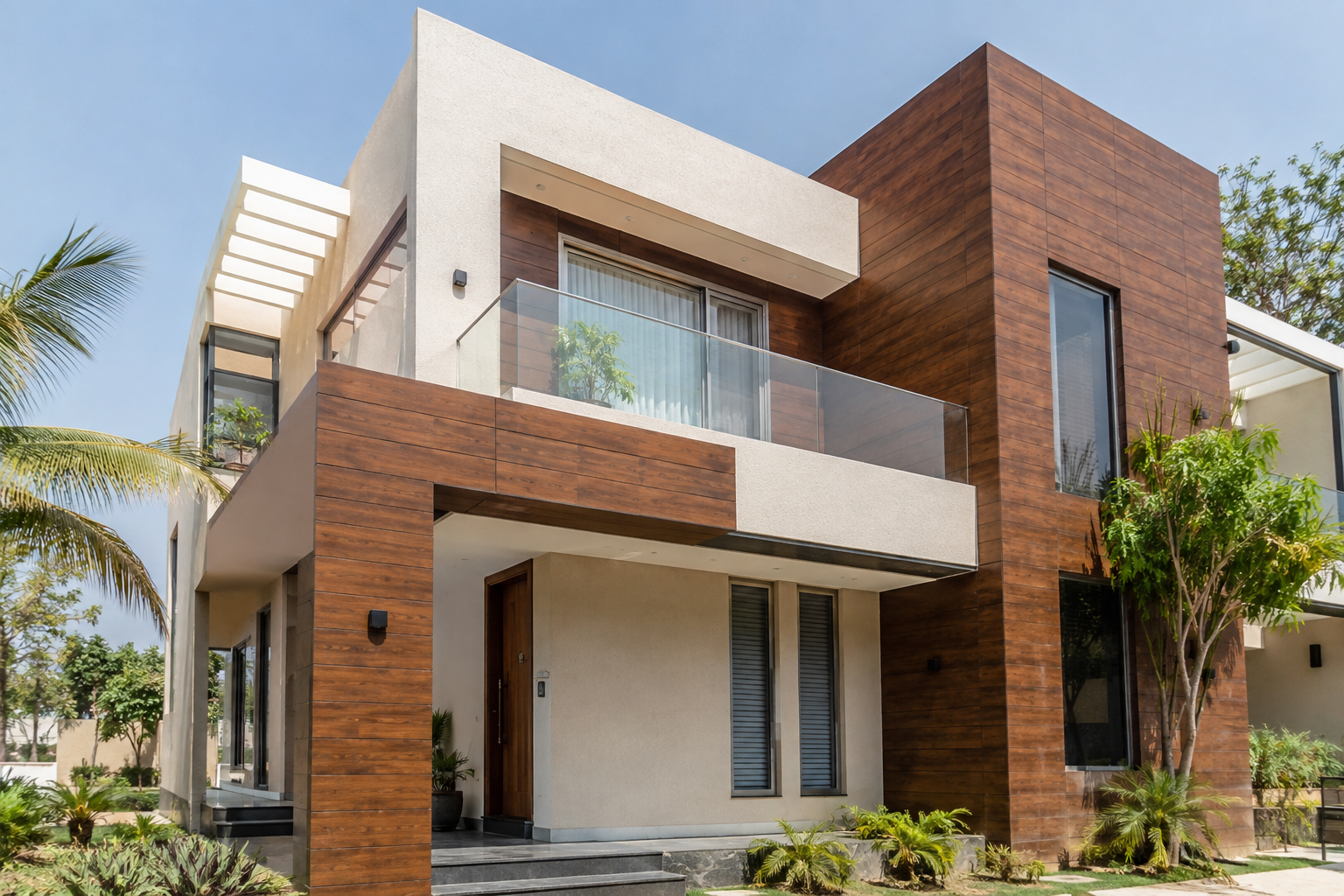
Mixed-material facades have become standard practice in contemporary design, and the reason is straightforward: a single material across a whole elevation reads as a surface rather than as architecture. Combining materials defines volumes and gives a building scale. The difficulty is always at the junctions.
Why Mixing Works
Different materials carry different weight, texture and light response. Used deliberately, that difference articulates a building — this volume is the entrance, that mass is the body, this element is the stair tower. A single finish flattens all of that into one plane.
Contemporary composition typically pairs a warm natural-look material at human scale with a neutral or mineral material on the larger mass.
Combinations That Work
HPL with natural stone
Stone on the plinth and lower levels, HPL above. This plays to each material honestly: real stone where people stand close enough to read its texture, lightweight HPL where weight and access cost matter. It also solves the structural loading problem that full-height stone creates.
HPL with glass
The most common commercial combination. Solid HPL panels between glazed bands give the facade rhythm and reduce the glazing ratio, which helps thermal performance. Key detail: the junction between panel and glazing system needs a designed interface, not an improvised one.
HPL with metal
Metal for fins, louvres, railings and trims; HPL for the field. The contrast between a warm wood-look and a cool metal element is reliable. Watch for galvanic issues where dissimilar metals meet in the framework.
HPL with exposed concrete
Strong pairing for contemporary work. Concrete’s mass and texture against a warm wood-look panel is a composition that has held up well. Requires good concrete, since HPL’s precision highlights poor formwork finish.
HPL with brick
Underused in India and very effective. Brick’s texture and warmth pairs with HPL in mineral greys or matte black rather than with wood-look, which competes.
The Junctions Are the Design
This is where mixed-material facades succeed or fail. Materials move differently, weather differently and are installed by different trades on different programmes.
- Differential movement. HPL, stone, metal and concrete expand at different rates. The junction detail must accommodate relative movement, not resist it.
- Water management. Every material change is a potential water path. Decide where water goes at each junction and detail it explicitly.
- Tolerance stack-up. Different trades work to different tolerances. Build in adjustment at the interface rather than assuming alignment.
- Sequencing. Which trade goes first determines what is buildable. Coordinate this in design, not on site.
- Transition detail. A shadow gap or reveal at a material change reads as intentional and hides tolerance. A flush butt joint between two materials almost never looks right in execution.
Composition Guidance
- Two primary materials, maximum three. Beyond that the elevation loses coherence.
- One material clearly dominant at roughly 60 to 70 percent of the area.
- Change materials at volume changes, not arbitrarily mid-plane. The material change should explain the architecture.
- Contrast texture or tone, not both aggressively. Similar tones with different textures often reads better than high contrast in both.
- Consider weathering rates. Materials that age differently will diverge over time. Plan for how the composition looks at year ten, not just at handover.
Frequently Asked Questions
How many materials should one facade use?
Two primary materials, occasionally three, with one clearly dominant at 60 to 70 percent of the area.
What pairs best with wood-look HPL?
Mineral greys, natural stone, exposed concrete and dark metal. Avoid pairing two different wood tones.
What is the main risk in mixed-material facades?
The junctions. Differential movement, water paths and tolerance mismatch at material changes cause most problems.
Should material changes align with the structure?
Generally yes. A material change that corresponds to a volume or plane change reads as intentional; an arbitrary change mid-wall does not.
Designing a mixed-material facade? Contact HPLMaker for junction details and technical support.